Wildlife in the News
- News Archive 2011
- News Archive 2010
- News Archive 2009
- News Archive 2008
- News Archive 2007
- News Archive 2006
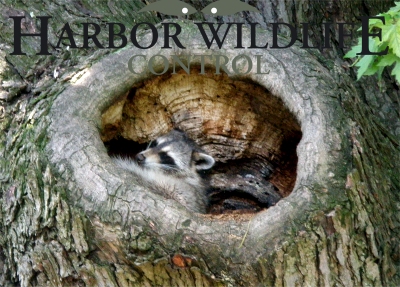 A "chillaxin'" Raccoon in a Tree |
The verminator: Pesky critters big or small, Laurence Harbor man gets them all
By Kevin Manahan/The Star-Ledger
Sunday, August 05, 2012, 8:13 AM
The raccoon looks awfully comfy — did she just yawn? — stretched out in the hollow of a tree roughly 10 feet above a redwood deck in a shady backyard in Staten Island. And, judging from the wood shavings scattered below, she has decided to hollow out additional living space, maybe an extra bedroom or a man cave for her mate or — heaven forbid! — a nursery.
Frank Spiecker of Harbor Wildlife Control already has spent 24 hours trying to lure her down with his secret-formula bait (don’t ask for the recipe, he ain’t tellin’) and two strategically placed traps. But that failed.
Spiecker was summoned from his Laurence Harbor office by a homeowner who had been sipping wine on his deck after a hard day of work when (insert freaking-out, cursing and screaming here) the raccoon leaped onto a table and went nose-to-nose.
The guy, who might need a defibrillator if it happens again, understandably wants the animal gone — like yesterday. And when homeowners and businesses want critters removed — anything from pythons (oh, yeah, he’s caught those) to pesky squirrels — Spiecker gets the call.
Exotic or mundane, he’s the man.
He props a ladder against the house, climbs up and snaps an overhead photo of the chillaxin’ critter to include with the bill. ("Customers like to see what they paid for," he says.) The raccoon might as well have smirked and winked at him as it sipped a piña colada in a recliner, because Spiecker is now ticked off that the capture is taking this long.
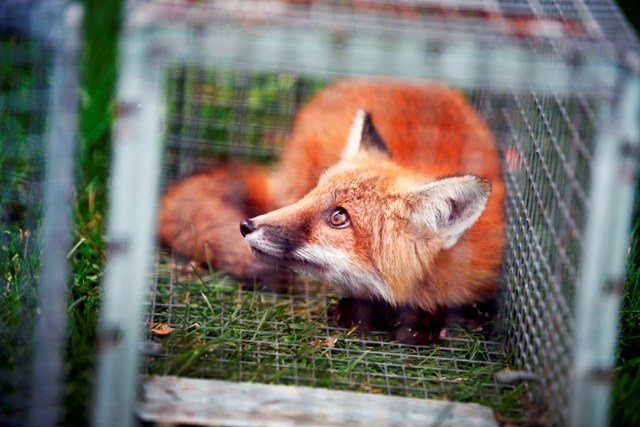 A captured fox pup |
"You’re coming down," he says. "Now."
Within a minute, Spiecker, perched on a ladder, has a snare looped tightly around the raccoon’s neck. But this isn’t going to be an easy eviction. She curls into a ball, digs her claws into the tree and hisses with hatred. Spiecker yanks hard on the pole, takes her to the deck and shoves her into a cage, all in a blink.
If this were an Olympic wrestling match, you’d need to watch the slow-motion replay to digest the entire takedown. Because, you see, the naked eye missed the part when the raccoon, uh, emptied her bladder. On Spiecker. Who is now hosing himself off.
"Glamorous job, huh?" he says with a chuckle. "Rule No. 1: When you have them in a snare, raccoons will pee themselves almost every time."
Business is booming for Spiecker these days. Foxes. Groundhogs. Squirrels. Raccoons. Birds. Snakes. Coyotes. Rats, bats and feral cats. They’re burrowing under sheds or platform decks, nestling in chimneys, breaking into attics or basements, or treating Dumpsters and garbage cans like all-you-can-eat buffets.
KEEPING THEM OUT
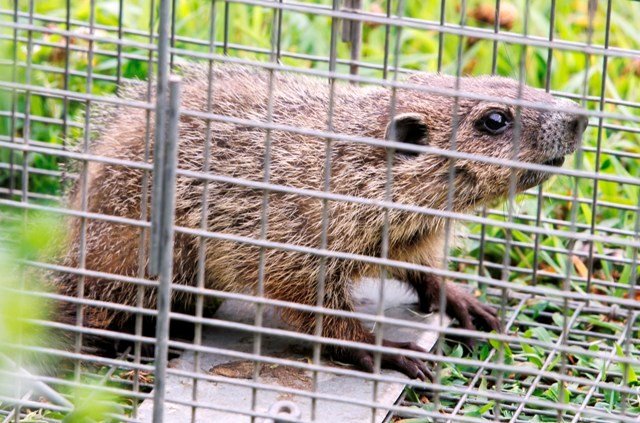 Captured Groundhog |
"Animals look at your house like it’s a tree," says John Griffin, director of wildlife services for the Humane Society of the United States. "If there’s a way in, they’ll find it. We hear people say all the time, ‘The animals are targeting me,’ but they’re not. They don’t care whose house it is.
"And when it comes to urban environments, they’re adapting very well. They’re very resourceful in finding food and shelter that people unwittingly provide."
The National Wildlife Federation estimates the nation’s largest 35 metro areas could lose another 22,000 square miles of green space by 2025. In other words, thanks to New Jersey (and New York) sprawl, man and creature are crossing paths more often than ever.
And when that happens, Spiecker’s phone rings. And rings. And rings. He’s one of a handful of wildlife control agents who handle the jobs that county and municipal governments won’t.
He doesn’t just catch the animals. Also a carpenter, he repairs the damage they’ve done to homes, then guarantees against the critters’ return: "I get ’em out and keep ’em out," he says. Animal Control Guy Specializes In Removing Unwanted Critters Animal Control Guy Specializes In Removing Unwanted Critters Frank Spiecker's business card reads "Solving Human & Wildlife Conflicts." What it really means is: If you've got an unwanted critter in your home or business (raccoon, bat, rat, fox or skunk, to name a few), Harbor Wildlife Control is the place to call. Spiecker retrieves two trapped foxes, releases a skunk and ground hog into the wild, and talks about everyday challenges of the job. Video by Mike Roy / The Star-Ledger Watch video
KEEPING THEM OUT
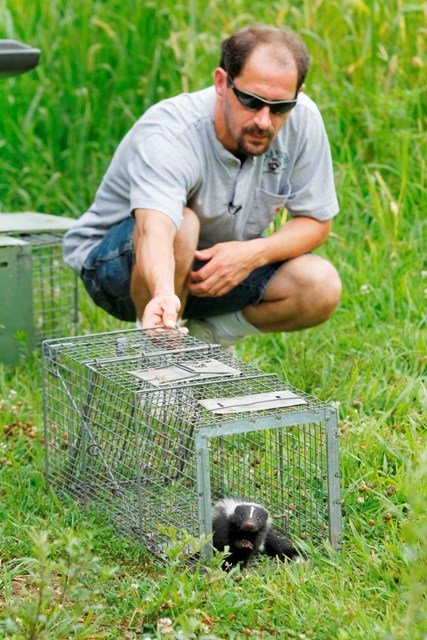 Releasing a Skunk |
Most towns have animal control officers, but the level of service varies by town. It’s a sign of the financial strain many are under.
"In these recent times, when you have limited dollars and limited personnel, it’s one of the services that very well may not be tended to," says Bill Dressel, who heads the New Jersey State League of Municipalities. "Public officials are sensitive to the needs of their constitutions and their citizens, and they will do what they can, but these are dire fiscal times we live in."
That’s good news for Spiecker.
Before tangling with the raccoon, he trapped two pup foxes from beneath a shed in Monmouth County; set up specially designed squirrel traps on the roofs of two Central Jersey homes; wrapped things up at a New Brunswick address, where he had trapped four groundhogs trying to mess up a homeowner’s freshly landscaped backyard; explained to a Bergen County woman by phone how to get an angry cat into a carrier (no charge); directed a Sussex County caller, who had a snake in her home, to a wildlife control agent in her neck of the woods; and, at a businessman’s request, cased a strip mall with a feral cat problem.
All that, and it was barely past noon.
"I’m usually busier than this," he says.
Spiecker has seen his share of crazy.
He recalls when one family spent a small fortune on landscaping, including a freshly sodded lawn. They awoke one morning to find the sod rolled up. Figuring it was a prank, they laid it back down. The next morning, it had been rolled up again. Eventually, Spiecker caught the culprits: raccoons who were after the grubs in the dirt, beneath the sod.
THE BIG SQUEEZE
And there was the python probably released by a pet owner who either went broke trying to feed it or became frightened when it grew to roughly 12 feet. Spiecker caught it in a backyard, but the massive snake tried to squeeze the life out of him. Wrapped tight, Spiecker breathlessly called to his father, who had come along only because the job was on the way to the gun range.
"Help me get it off!" Spiecker yelled.
"No way," his father said. "I don’t get paid for this, you do!"
Spiecker caught an alligator, too, in 2004, but lost a chunk of flesh. Some knucklehead had turned his basement into a gator lair, with sand and a kiddie pool. But when he had a beef with family members, they got even by reporting him (and his fast-growing illegal pet) to authorities. They called Spiecker.
"Probably because nobody else would be crazy enough to mess with it," Spiecker says.
The wild animals Spiecker catches are euthanized or relocated, depending on the laws governing the area and the animals, Spiecker says. He insists he does "everything by the book," and then holds up the book of regulations, which he keeps in his truck. In New York, nuisance wildlife control agents must be licensed. In New Jersey, no license is needed.
Spiecker began trapping in and around Laurence Harbor when he was knee-high to a gopher — even sneaking out of Cedar Ridge High School in the 1970s to trap during lunch hour with his buddies. They hung the animals in their lockers, then smuggled them home on the bus, he says. Raccoon pelts went for $40; muskrats for about $18, he says.
He recently was elected president of the New Jersey chapter of the National Wildlife Control Operators Association, and if there’s one thing he’s learned about varmints, it’s this: No home is immune.
On the way to the next job, Spiecker stops for coffee and fields a call. A groundhog has invaded a Central Jersey yard. Spiecker gives the caller a price: $130 to set up, $110 for every animal caught in the trap — until the groundhog is captured. (Sometimes the targeted animal is not the first one caught.)
The woman mistakenly believes Spiecker works for the municipality.
"What, this isn’t a free service?" she says.
"No," he answers.
"Well, I ain’t payin’ for you to get rid of no groundhog."
"Okay, ma’am," Spiecker says. "Thanks for calling. You have a nice day."
He hangs up and grins.
"And I’ll be here next week when you call back."
Star-Ledger staff writer Ryan Hutchins contributed to this report.
http://www.nj.com/news/index.ssf/2012/08/the_verminator_pesky_critters.html
Star Ledger Report
|
Animal Control Guy Specializes In Removing Unwanted Critters
By Mike Roy/The Star-Ledger
July 26, 2012, 8:30PM
Frank Spiecker's business card reads "Solving Human & Wildlife Conflicts." What it really means is: If you've got an unwanted critter in your home or business (raccoon, bat, rat, fox or skunk, to name a few), Harbor Wildlife Control is the place to call. Spiecker retrieves two trapped foxes, releases a skunk and ground hog into the wild, and talks about everyday challenges of the job. Video by Mike Roy / The Star-Ledger
http://videos.nj.com/star-ledger/2012/07/animal_control_guy_specializes.html
Feline causes uproar
Savannah cat spotted, caught, reunited with its area owner
by Susan Loyer • Staff Writer
March 17, 2012
News 12 Reports on Serval/Savannah Cat
|
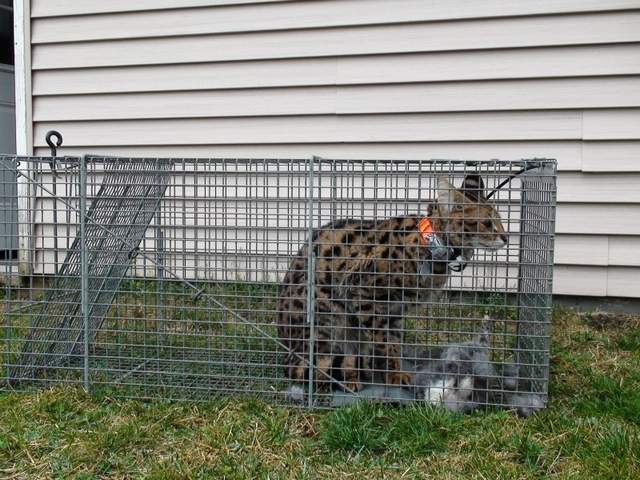 Savannah cat found in Old Bridge / Courtesy Harbor Wildlife Control in Old Bridge |
OLD BRIDGE — A Savannah cat caused a bit of a stir in the Cedar Ridge Estates development on Thursday.
Police responded to a report of a large cat, about the size of a small leopard, running in the Pemberton Drive neighborhood about 5:48 p.m., Old Bridge Township Police Captain Robert Bonfante said.
Upon arrival, police began canvassing the area.
The Savannah cat, a cross between a serval and domestic cat, had been mistaken for a mountain lion by some neighbors in Cedar Ridge Estates, Frank Spiecker of the Old Bridge-based Harbor Wildlife Control, said. Residents started to fear for their pets’ safety, while the unidentified cat was running at large, he said.
Prior to the cat’s capture, it had taken a pet rabbit from a backyard of a home in the neighborhood, Spiecker said.
Spiecker was called to the scene and traps were set up in the neighborhood.
“Not long after I got a call from police that the cat was sitting on someone’s front porch chaise lounge,’’ he said.
Because the cat was wearing a radio tracking collar, Spiecker believed it belonged to someone and didn’t want to see the cat euthanized.
Eventually, Spiecker was able to use a snare pole to catch the cat.
The cat has been missing since November, Spiecker said. A Cedar Ridge Estates’ resident thought they had seen a flier about the cat some months ago.
Police eventually located a flier and contacted the owner, who also lives in the development.
Spiecker said he would be reuniting the cat and its owner Friday evening.
Susan Loyer: 732-565-7243; sloyer@ njpressmedia.com
Cat-astrophe averted
By Mike Frassinelli, STAR-LEDGER STAFF
March 17, 2012
OLD BRIDGE - With each passing day, the legend of the Middlesex County "mountain lion" continued to grow.
A huge cat in Old Bridge was 3 feet tall, according to one description, and it had a big, wide head!
Frank Spiecker didn't see a mountain lion he was expecting when he went to the Cedar Ridge Estates development Thursday.
But what he saw was a first for the wildlife control company president, who deals with alligators, muskrats, beavers and boa constrictors.
It was an orange-and-black spotted Savannah cat with long legs and ears, on a porch, hissing and growling.
"Put it like this -- it's related to a cheetah," said Spiecker, who owns Harbor Wildlife Control.
Earlier in the afternoon, the big cat had reached into a cage on a porch and killed a domestic rabbit.
Using a pole snare, Spiecker maneuvered the 30-pound animal into a cage.
It was determined the cat belonged to a man on a nearby street and had been fending for itself for six months.
Spiecker last night was going to return it to the owner, who was said to have spent $15,000 to buy the exotic animal and in the fall sent out fliers in the neighborhood about the missing cat. Carlos Pou was at work when he got the harried call from his wife.
"There's a leopard in the backyard!" Marcelle Pou screamed.
Carlos Pou chalked it up to the mood swings that can accompany the early part of pregnancy, but rushed home. After the cat killed her 7-year-old son's pet rabbit as the boy arrived home from the school bus, Marcelle Pou's motherly instincts kicked in, and the pregnant woman chased off the big cat with a broom. Even though he felt bad for his son, Carlos Pou couldn't help but admire the big cat that was doing what it had to do to survive six months outside.
"This thing," he said, "was awesome."
Middletown Health Dept. issues rabies alert
Independent, Greater Media Newspapers
August 8, 2012
The Middletown Township Health Department has received laboratory confirmation of a bat testing positive for rabies. This new report brings the total number of wild animals testing positive for rabies this year to five, one bat and four raccoons, according to a press release from the township.
The bat was tested after it was found to be in altercations with a dog in the area of Bryna Drive, located in the Lincroft section of Middletown. Since the dog was up to date on its rabies vaccination the canine only needed to receive a rabies booster and a 45-day quarantine, according to Health Department Director Rich DeBenedetto.
In light of finding a rabid bat, residents are reminded about the possibility of wildlife being infected with rabies. Residents are advised to be sure all domestic animals -- dogs, cats and livestock -- are currently vaccinated for rabies. If this dog had not been currently vaccinated, the owner would have been ordered to confine the animal for six months in an approved pen or facility, or humanely euthanized to protect the family members from possible exposure to the rabies virus, according to DeBenedetto.
If bats are discovered nesting anywhere in a home, the homeowner should contact a licensed professional pest control service. Residents who encounter a sick or injured animal, are advised to keep their distance and contact animal control at 732-615-2094 or 2097 immediately or contact the police department after hours and on weekends. Rabies is a fatal disease. The best course of defense is the vaccination of pets and not handling or interacting with wildlife, the press release states.
Rabid Bat Reported In Piscataway
August 14, 2012
New Jersey News from WWW.NJTODAY.NET
PISCATAWAY, NJ — The Middlesex County Office of Health Services is reporting that a bat tested positive for rabies in Piscataway, in the vicinity of Pleasant Avenue and West 4th Street.
This is the fifth rabid animal reported within Middlesex County for 2012, and the first reported in the municipality of Piscataway.
On August 12, the Piscataway Animal Control Officer responded to a report that a bat was found inside a resident’s home. The Animal Control Officer captured the bat and it was sent to the New Jersey State Department of Health Laboratory for testing. It was reported today that the animal tested positive for rabies. The Middlesex County Office of Health Services is distributing rabies advisory flyers and fact sheets in the area.
The Middlesex County Office of Health Services continues to monitor rabies cases within the County. Residents should report wild animals showing signs of unusual behavior to their local Animal Control Officer. Additionally, it is recommended that residents should avoid contact with wild animals and immediately report any bites from wild or domestic animals to the local health department and consult a physician as soon as possible. Finally, be sure that all family pets are up to date on their rabies vaccinations and licenses.
Rabies is caused by a virus which can infect all warm-blooded mammals, including man. The rabies virus is found in the saliva of a rabid animal and is transmitted by a bite, or possibly by contamination of an open cut. New Jersey is enzootic for raccoon and bat variants of rabies. Bats, raccoons, skunks, groundhogs, foxes, cats and dogs represent about 95 percent of animals diagnosed with rabies in the U.S.
Read more. Tell everyone to get New Jersey News from WWW.NJTODAY.NET
| Middlesex County | Monmouth County | Somerset County | Union County | Warren County |
| Sussex County | Morris County | Essex County | Hudson County | Hunterdon County |
Mercer County